News
Is Missouri About to Make XRP an Official State Reserve Asset?

by Soumen Datta
March 23, 2026


Missouri's HB 2020 proposes adding XRP to a state-managed Digital Asset Reserve Fund alongside Bitcoin and Ethereum. Here's what the bill says and where it stands.
Missouri is actively moving toward it. The state's House Bill 2020 has recently passed out of committee with a "do pass" recommendation and now heads to the full Missouri House for a debate and a vote.
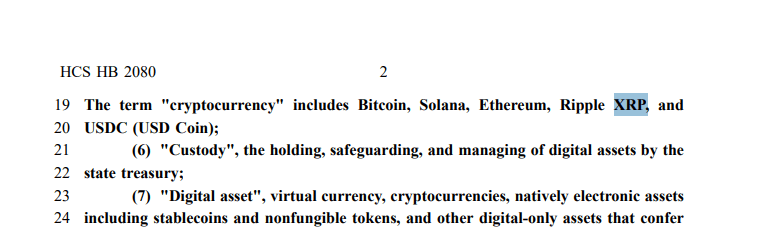
If the bill becomes law, it would authorize the state treasurer to hold XRP alongside Bitcoin, Ether, Solana, and USDC as part of an official Digital Asset Reserve Fund.
What Is Missouri's HB 2020 and What Does It Propose?
HB 2020 is Missouri's legislative push to create a Cryptocurrency Strategic Reserve Fund, a state-managed pool of digital assets that the state treasurer would be permitted to invest in. XRP is named as one of the eligible assets in the bill, which places it alongside some of the most widely held cryptocurrencies.
This is not a minor local policy move. Arizona is separately advancing a similar bill, suggesting a broader pattern among U.S. states to formalize crypto exposure at the treasury level. Analysts tracking state-level crypto legislation expect more states to follow, though timelines will vary.
Is XRP Ready for Institutional Use at This Scale?
The XRP Ledger (XRPL) recently crossed 7.7 million non-empty wallets for the first time in its 13-year history, according to on-chain analytics platform Santiment. On the same day that milestone was reported, active addresses hit 46,767 (the highest in five weeks), and XRP's price climbed 14% in a 48-hour window, briefly touching $1.60.
The XRPL's technical design has long been built around three characteristics that matter for institutional use:
- Near-instant settlement, typically three to five seconds per transaction
- Transaction fees that stay well below one cent
- An energy-efficient federated consensus model, which does not rely on mining
Unlike proof-of-work blockchains such as Bitcoin, XRPL uses a network of validators that agree on transaction validity directly. That design keeps energy costs low and processing fast.
From March 30, the European Central Bank is scheduled to begin accepting tokenized collateral, and XRPL's infrastructure has been identified as part of that process. That places the ledger inside Europe's formal financial system in an operational role, not a speculative one.
Ripple also recently released version 3.1.2 of the XRP Ledger software. The update patches a security vulnerability that could cause validator servers to crash or restart unexpectedly. For institutions depending on consistent uptime in settlement or collateral workflows, that kind of maintenance matters.
Real-World Adoption: What iPayOut's Partnership Signals
Beyond state legislation, Ripple's infrastructure is being integrated by iPayOut, a global payouts platform that serves workers, merchants, and partners through a unified API. The company's president, Eddie Gonzalez, has described Ripple as "the right partner" for its digital marketplace strategy.
"The digital marketplace is important to the future, and Ripple is the right partner to take us there." — Eddie Gonzalez, President, i-payout
— Ripple (@Ripple) March 16, 2026
Ripple Payments helps i-payout deliver real-time payouts into the U.S. & Canada, from days to seconds. 🌎
See how →… pic.twitter.com/WWNmJc9utQ
The integration covers cross-border payment flows in the U.S. and Canada and is designed to speed settlement, improve transaction transparency, and reduce working capital demands for high-volume platforms.
Where Does Missouri's XRP Bill Go From Here?
Missouri's HB 2020 is one legislative vote away from moving XRP closer to something it has never been before: an officially recognized state treasury asset. The bill's "do pass" committee recommendation gives it real momentum, and Arizona's parallel effort suggests this is not an isolated experiment.
The on-chain data backs the timing. XRPL's holder count is at an all-time high, daily transactions have crossed 2.7 million, and institutional integrations are moving from announcements to live infrastructure. The ECB's tokenized collateral framework and iPayOut's payment rails are not future possibilities; they are scheduled and signed.
Resources
Blog article by XRP Ledger: Introducing XRP Ledger version 3.1.2
Santiment on X: Post on March 17
Disclaimer
Disclaimer: The views expressed in this article do not necessarily represent the views of BSCN. The information provided in this article is for educational and entertainment purposes only and should not be construed as investment advice, or advice of any kind. BSCN assumes no responsibility for any investment decisions made based on the information provided in this article. If you believe that the article should be amended, please reach out to the BSCN team by emailing info@bsc.news.
Author
Soumen Datta
Soumen has been a crypto researcher since 2020 and holds a master’s in Physics. His writing and research has been published by publications such as CryptoSlate and DailyCoin, as well as BSCN. His areas of focus include Bitcoin, DeFi, and high-potential altcoins like Ethereum, Solana, XRP, and Chainlink. He combines analytical depth with journalistic clarity to deliver insights for both newcomers and seasoned crypto readers.
Related News
Latest News
7h : 15m ago
XRP Staking Platform Firelight Sees Dramatic TVL Surge

7h : 55m ago
TRON DAO Expands AI Fund to $1 Billion

14h : 0m ago
Ethereum Foundation Redefines L1 And L2 Roles In New Roadmap

16h : 0m ago
MrBeast Under Fire Over Crypto Plans For Kids Banking App
March 23, 2026
Two Major Upgrades as InterLink Hits 7M Users
March 23, 2026
Blockchain Gaming is Dead Proclaims Solana Foundation President

March 23, 2026
CLARITY Act Got Its Biggest Break Yet — Is Crypto Law Finally Happening?
March 23, 2026
Google Chrome Got a Critical Security Patch, But Your Crypto Wallet Might Still Be at Risk